Tankless vs Tank Water Heater in Windsor, CO: Which Fits?
Tankless units save energy and last longer, and they cost more to install. Whether they fit your house depends on a few specifics.
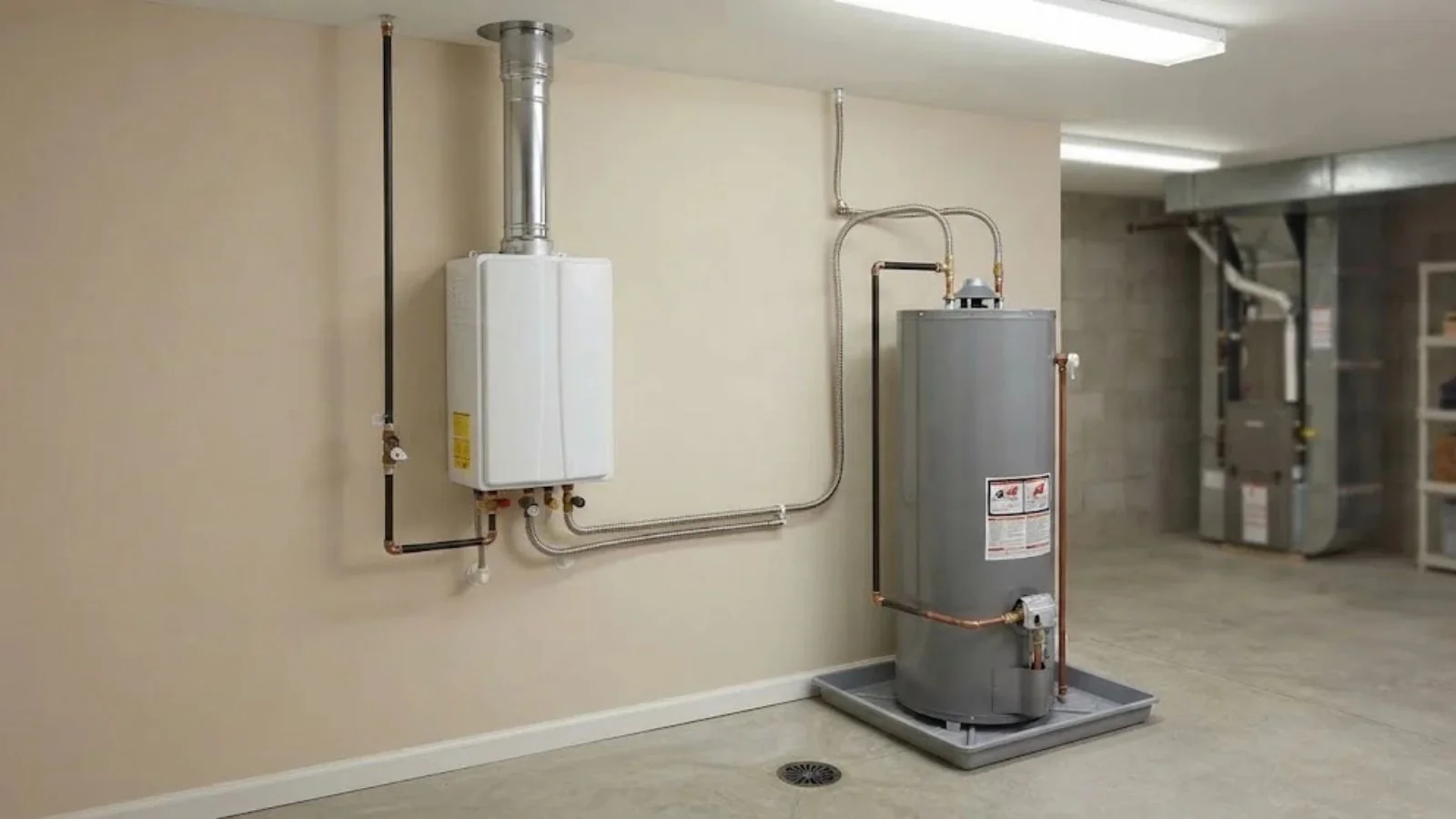
What each type actually does
A tank heater keeps 40 to 75 gallons hot all day and loses a little heat constantly. A tankless heater heats water only when you draw it, so it has no standby loss, but it must heat the water instantly, which takes a lot of gas or electric power. Both types work well when matched to the house.
The U.S. Department of Energy reports that tankless heaters can be 24 to 34 percent more energy efficient than storage tanks in homes that use about 41 gallons or less per day. In homes that use a lot of hot water, around 86 gallons per day, the gain is 8 to 14 percent. They are also expected to last more than 20 years, compared with 10 to 15 years for a storage tank.
Tank vs tankless for a Windsor home
| Factor | Tank | Tankless |
|---|---|---|
| Typical life (DOE) | 10 to 15 years | More than 20 years |
| Energy use | Constant standby loss | No standby loss, and more efficient at low use |
| Hot water supply | Limited by tank size, then recovery | Continuous, up to the unit's flow limit |
| Gas line and venting | Standard | Often needs a larger gas line and special venting |
| Scale sensitivity | Sediment collects slowly | Heat exchanger needs periodic descaling |
| Space | Needs floor space | Wall-mounted, saves floor space |
Three Windsor-specific factors
Altitude is the first. Windsor sits at about 4,800 feet, and gas appliances need to be set up for altitude per the manufacturer. A tankless unit with settings meant for lower elevations can misfire or throw codes. Ask any installer how the unit will be configured.
The gas line is the second. A tankless heater can draw several times what a tank heater does, so the line from the meter may need upsizing, and venting may change. That adds to the installed cost.
The third is water. The Town of Windsor buys about 30 percent of its water from Greeley and about 70 percent from two districts, and hardness is not published in the Town's report. Ask your supplier before choosing, because a tankless unit on harder water needs more frequent flushing.
Which one fits which household
Tank fits when
- The budget is tight and the install should be simple
- The gas line is small and hard to change
- Hot water use is modest and steady
- Space is not a constraint
Tankless fits when
- You plan to stay for many years
- Floor space is tight
- Hot water demand is high and runs back to back
- The gas line and venting can be upgraded
How to check whether a tankless unit can keep up
Federal rules cap showerheads at 2.5 gallons per minute and most kitchen faucets at 2.2. Two showers and a running dishwasher can easily draw 6 or more gallons per minute. A tankless unit's rating depends on how much it must raise the temperature, and Colorado's incoming water in winter is often in the 40s Fahrenheit, which means a rise of roughly 70 to 80 degrees to reach 120.
That temperature rise is why a unit that supports 5 gallons per minute at a mild rise delivers less on a cold January day. A good installer sizes the unit for the coldest water, not the average.
What goes into the installed cost
- The unit itself, which usually costs more than a tank.
- A larger gas line and possibly a new meter or regulator setting.
- Venting, which is often different from a tank's flue.
- Electrical power for the control board and fan.
- Service valves for flushing, a condensate drain for condensing models, and a permit.
- Disposal of the old tank.
Wait time and recirculation
Tankless units do not eliminate the wait for hot water at a far fixture. The water already sitting in the pipe has to run out first. A recirculation pump or a small point-of-use tank helps, but both add cost and use energy.
Tank heaters have the same wait, and the practical question is how far the heater is from the fixtures you use most. A compact floor plan helps either type.
Warranty and maintenance conditions
Read the warranty before buying. Many tankless manufacturers expect annual flushing in harder water, and a missed flush can complicate a claim. Tank warranties often cover the tank for several years and the parts for less.
Keep the receipt and the maintenance records. A simple log, with the date of each flush and any repair, is often all that is needed to support a claim years later.
How to decide
Count the household's peak simultaneous use, check the gas line size and the venting path, and ask for a quote that includes any gas, venting, electrical and permit changes. Compare it to a like-for-like tank, not just the sticker price. The Town of Windsor requires a permit to install or move plumbing, so ask about that too.
For tankless questions the page on tankless water heater service covers flushing and error codes, and water heater installation and replacement covers sizing and swaps. Homeowners in Severance with newer builds often have gas lines sized for a tank, so ask early.
Quick answers
Often, especially in lower-use homes, but installed cost and gas line upgrades affect payback. The DOE figures above are efficiency, not savings promises.
They supply hot water continuously up to their flow limit. Running several showers and a dishwasher at once can exceed it.
No. A well-sized tank is simple, proven and cheaper to install.
Manufacturers often set a yearly flush for tankless units, and harder water can justify a shorter interval.
Choosing a water heater?
Call for a sizing check and a written quote that includes gas and venting.
☎ (970) 708-6013