Where Is the Main Water Shut-Off Valve in a Colorado Home?
In a burst pipe, every minute counts. Finding the main shutoff takes ten minutes now and saves thousands of dollars later.
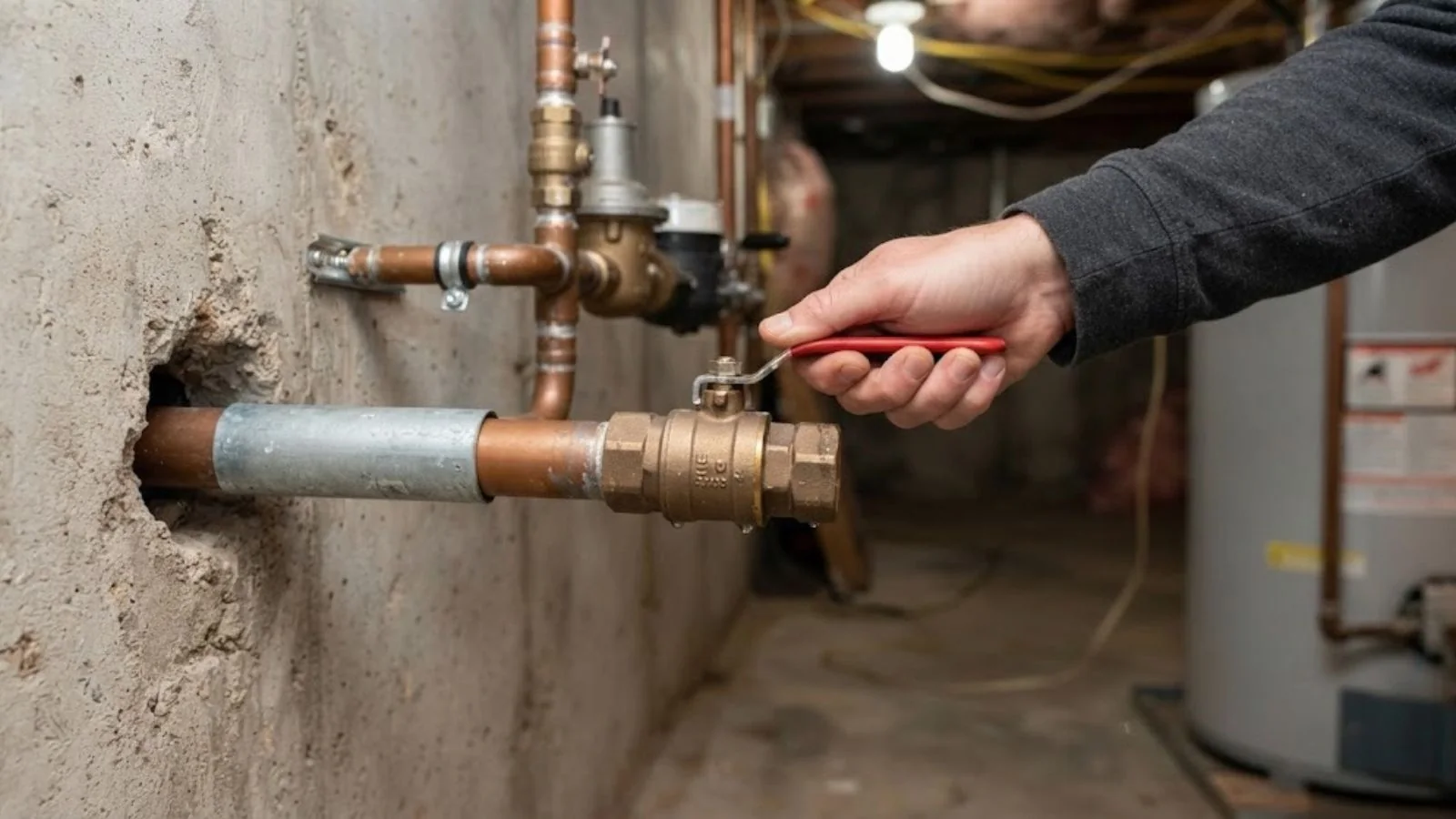
The valve you need in a hurry
Hundreds of gallons can leave a split pipe in an hour. The main shutoff valve stops the supply to the whole house, and it is the first thing to close in a leak you cannot isolate. Most people do not know where theirs is until they need it.
The International Plumbing Code (IPC) requires a shutoff valve where water enters a building, so every code-built house has one. Test it once now, while nothing is wrong. A valve that has not moved in years may be stuck or may leak when first turned.
Common locations by type of home
| Home type | Where to look | What it looks like |
|---|---|---|
| Home with a basement | On the wall facing the street, where the water line enters, often near the water heater | A lever handle or round wheel on a pipe, sometimes next to a meter |
| Crawl space home | Near the entry point or under the bathroom | A valve on the pipe, reached through an access panel |
| Slab-on-grade home | A utility closet, the garage, or near the water heater | A valve on the line before it branches |
| Newer subdivision | A mechanical room, a basement corner or a garage wall | A valve and a pressure regulator near each other |
| Outside the house | A meter box in the front yard or at the curb | A lid marked water, with the provider's meter inside |
The valve at the meter or curb usually belongs to your water provider, so do not operate it unless the provider tells you to. If the house valve is stuck, a plumber can replace it without touching the provider's side.
Ball valves and gate valves
Ball valve
- A lever handle that turns a quarter turn
- Parallel to the pipe means open, across means closed
- Seldom seizes
- Easy to use in a panic
Gate valve
- A round wheel handle turned several times
- Clockwise to close
- Can seize or break after years unused
- Consider replacing with a ball valve
How to test your main shutoff
- 1
Find the valve and the meter
Note where the water line enters and where the valve sits.
- 2
Turn it off
Close the valve slowly, then open a faucet to confirm the flow stops.
- 3
Check for leaks at the valve
Dry the valve and look for weeping at the stem.
- 4
Turn it back on
Open the valve fully, then open a faucet to purge air.
- 5
Tag it
Put a bright tag on the valve and show everyone in the household.
Smaller shutoffs matter too
Every sink, toilet, washer and dishwasher should have its own shutoff. A failed supply line at one fixture can then be stopped without turning off the whole house. These valves stick when they are never used, so turn each one off and on once a year, gently, and replace any that weep.
Turn off the water heater power or gas before closing the main for a long period. A heater that loses water supply while heating can overheat, and a dry electric element burns out within seconds. Write that number on the same card as the shutoff location.
Making sure everyone can find it
Show everyone in the household where the valve is and how it turns. Write the location on the inside of a cabinet door near the kitchen, and put a tag on the valve itself. If you rent a house or share one, ask the landlord where the valve is when you move in, not when you need it.
Pressure regulators near the main
Many homes have a pressure reducing valve near the main shutoff, a bell-shaped brass fitting that brings street pressure down to a safe level. Know where it is. If it fails, pressure at every fixture rises, and the first sign can be a dripping hose bib or a banging pipe. A gauge on a hose bib confirms the number.
The International Plumbing Code limits static pressure to 80 psi, and a regulator that has drifted above that is a repair worth making before it breaks a fitting.
Seasonal and vacant homes
For a house that sits empty over winter, close the main, open the lowest faucet and the highest to drain the lines, and set the water heater to vacation mode or off. If you plan to return, ask a neighbor to check the house after any hard freeze. A closed main is the cheapest protection a vacant house can have.
If you rent
Ask the landlord for the location of the main shutoff and write it down. In an apartment or a condo, there may be an individual unit shutoff and a building main that only maintenance can reach. Knowing who to call, and the number, beats fumbling in the dark.
When the leak is not in the house
If water is running in the street, the leak is on the provider's side of the meter. For a leak or break in the Town of Windsor's system, the Town's after-hours line is 970-674-5415. For a leak between the meter and the house, the repair is covered under water line repair and replacement, and a burst inside is a burst pipe repair call.
Homeowners in Severance and elsewhere should check which utility serves their address before an emergency, so the right number is on the fridge.
Quick answers
Several full turns clockwise. If it will not turn, do not force it. Call a plumber to replace it.
For a long absence in winter, yes, and also drain the lines if you can. For short trips, closing the main is cheap insurance.
In a box at the curb or front yard, or inside in a basement or utility room, depending on the home.
Look near the water heater and where the line enters the house. A plumber can find and, if needed, replace it.
Cannot find your shutoff?
Call and we will help locate it or replace a stuck valve.
☎ (970) 708-6013