How to Find a Hidden Water Leak in Your Windsor, CO Home
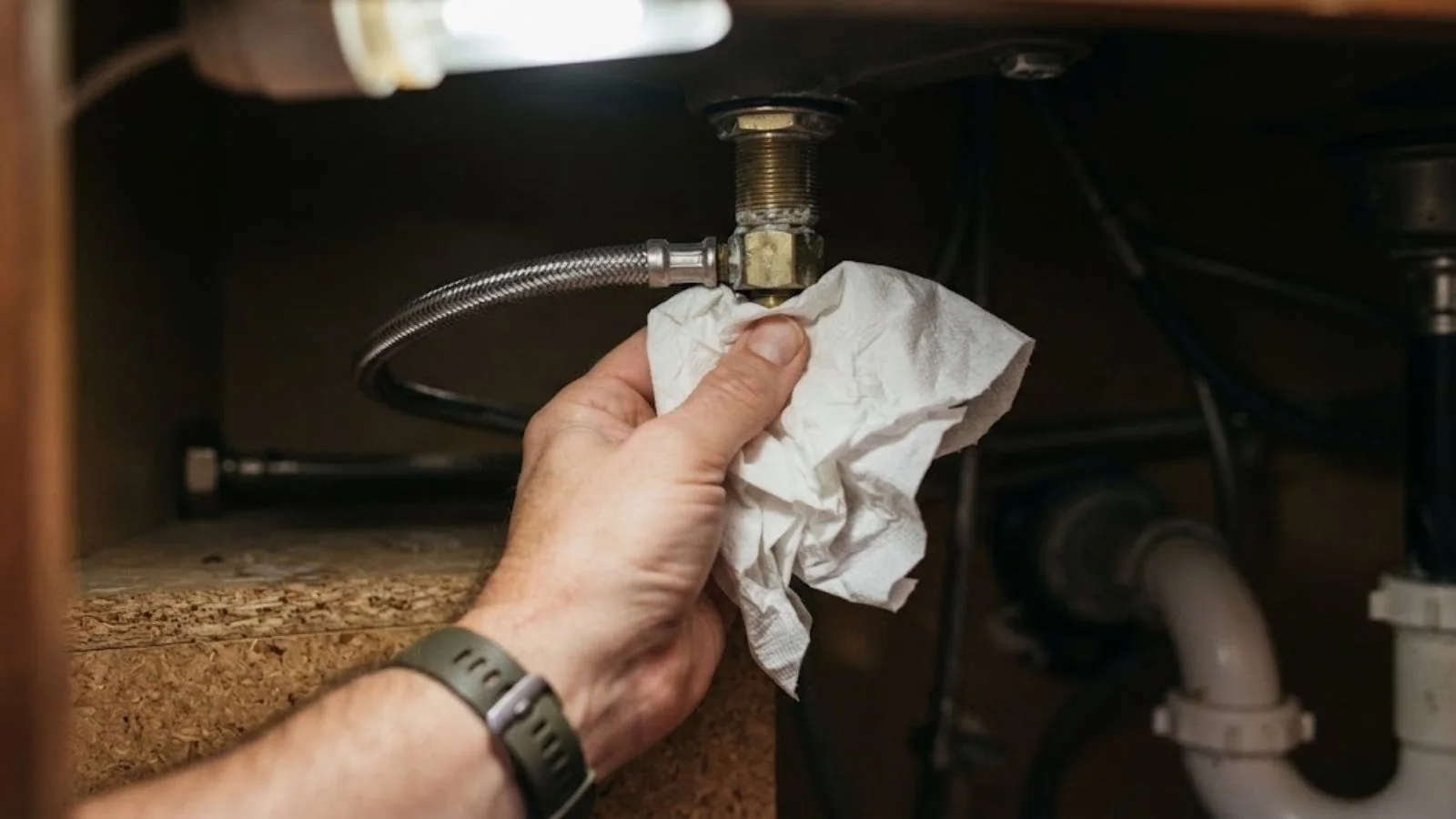
Most hidden leaks leave clues long before they leave a puddle. This guide goes room by room, and the tests need nothing more than a flashlight and a paper towel.
The signs that water is going where it should not
A musty smell in a closed room, paint that bubbles or peels, and a ceiling stain that grows after an upstairs bathroom is used are all signs. So are a floor that feels warm or spongy, running water heard at night, and mineral crusts on a basement wall. Mold with no humidity source is another.
Leaks run along pipes, wicking into drywall and framing, so the stain is often not where the leak is. A stain on a basement ceiling points to the bathroom or kitchen above, not to the ceiling itself.
Common hidden leaks by room
| Room | Common hidden leak | How to check |
|---|---|---|
| Kitchen | Dishwasher supply, sink supply lines, ice maker line | Dry paper towel on connections, flashlight under the sink |
| Bathrooms | Toilet supply, wax ring, shower valve behind the wall | Dye in the tank, check the base, look for ceiling stains below |
| Laundry | Washer hoses and the standpipe | Look behind the washer, and check the hose age |
| Utility room | Water heater fittings and relief valve | Inspect the base, the connections and the discharge pipe |
| Basement | Pipes in the ceiling, foundation seepage | Stain patterns, damp at the wall base, moisture meter |
| Outside | Hose bibs, irrigation zones | Run each zone, and check for soggy ground |
Simple tests you can run yourself
- Dry paper towel test: wipe each supply connection and look for damp.
- Dye test: add food coloring to each toilet tank and look at the bowl after 15 minutes.
- Appliance check: pull out the washer and dishwasher and look at the hoses and the floor beneath.
- Water heater look: check the base for rust or drips and the relief valve discharge pipe.
- Pressure feel: a sudden drop in pressure at all fixtures can mean a leak on the main line.
What the equipment adds
When the simple tests find nothing, professionals add instruments. A moisture meter reads wetness in drywall and wood. A thermal camera shows cool or warm patches behind surfaces. Acoustic listening picks up the hiss of pressurized water in a pipe, and a pressure test separates a supply leak from a drain leak.
The International Plumbing Code (IPC) tests new piping by holding pressure and watching the gauge, and a leak search borrows the same logic. Those tools are the heart of leak detection, and they let the opening in a wall be the size of a hand and not the size of a room. For leaks in concrete floors, slab leak detection and repair covers the extra steps.
What to watch for in a Northern Colorado house
Many Windsor-area homes have basements, which makes the basement ceiling a useful reporter for the floors above. In river-valley towns such as Johnstown, groundwater can mimic a pipe leak, so a moisture check should separate seepage from plumbing. A dry week with a still-damp wall suggests a pipe, and a wall that dries and re-wets after rain suggests groundwater.
Reading a stain
A stain with a dark outer ring and a lighter center often means water came and went several times, and a damp, spreading stain means the leak is active. A brown stain often means rust or old water, and a white crust on masonry is mineral left behind as water evaporated. Mark the edge of a stain in pencil with the date, and see if it grows.
Where the stain sits tells you where to look. Directly under a bathroom, suspect the toilet, tub or shower. Along an exterior wall, suspect a hose bib line or a window leak. In a corner near a roof line, suspect the roof, not the plumbing.
What not to do while hunting
- Do not cut large holes in drywall before you have a reason.
- Do not paint over a stain until the cause is found.
- Do not ignore a musty smell in a closed room.
- Do not run fans on a wet ceiling with exposed insulation.
- Do not assume the leak is where the stain is.
What a thermal camera can and cannot show
A thermal camera shows temperature differences, not water directly. A wet wall can look cooler than a dry one because water evaporates, and a hot water leak can show warm. Readings are interpreted with a moisture meter, and results are best when the camera is used by someone who knows what a false signal looks like.
That is why the tools work as a set. The meter confirms moisture, the camera maps it, and acoustic listening finds a pressurized leak that neither can see.
Moisture, mold and the 48-hour rule
Wet building materials can grow mold within a day or two. The EPA advises drying wet materials within 24 to 48 hours. If a leak has been wetting a wall for weeks, do not rely on the surface. Opening a small inspection hole may be needed to see the framing, and a restoration professional can advise on removal.
Signs that justify a call
Call when the meter moves with everything off, when a stain keeps growing, when a floor is warm, or when you hear water running with no fixture open. Close the main shutoff first if water is visibly spreading. A leak that is slow does not need an emergency call, but it does not get cheaper with time, and it damages framing and insulation silently.
Quick answers
Yes. Wet drywall and framing can grow mold quickly. The EPA advises drying wet materials within 24 to 48 hours.
Many manufacturers suggest replacing them every 5 to 10 years. A burst hose is one of the more common causes of home water damage.
A supply leak usually does. A drain leak does not, since the water has already been metered.
Some policies cover the access cost for a covered leak. Check with your agent before work begins.